
Fashion, Guides, Leather Jacket Tips
How to Pick the Right Leather Jacket for Your Body Type
The Anatomical Audit: Engineering the Perfect Fit
A high-end leather jacket is more than a style statement; it is a structural layer that must align with your physical frame. When the fit is correct, it reinforces your silhouette, adding perceived shoulder width and a tapered waist. However, leather is an unforgiving material—if the cut doesn’t match your body type, the jacket becomes a boxy, restrictive shell. At America Jackets, we prioritize “Anatomical Mapping,” ensuring that whether you choose a heritage cowhide or a lightweight synthetic, the garment functions as an extension of your natural build.
This guide serves as a technical manual for selecting a jacket based on your specific body shape. We’ve stripped away the fashion fluff to focus on the mechanics of the “Master Tailor” fit. By understanding how different styles—from aggressive bikers to streamlined bombers—interact with different frames, you can make a calculated investment that enhances your profile and survives your daily grind.
The Mechanics of the “Master Tailor” Fit
The primary objective of a fitted leather jacket is to achieve structural balance. A precision-cut piece will emphasize the “V-taper” of the torso, seating the shoulder seams exactly at the edge of your frame while maintaining a trim waistline. Any deviation from this creates an unrefined, boxy effect that ruins the industrial aesthetic. Whether you are looking for the rugged patina of a Men’s Leather Jacket or the immediate, non-boxy drape of a high-grade Vegan Leather build, the technical requirements for your body type remain the same.
Every body type requires a specific strategy. A heavy-duty Women’s Leather Jacket requires different chest clearance and waist tapers than a heritage flight jacket. By focusing on your specific anatomical needs, you ensure that your gear doesn’t just look good standing still, but allows for fluid movement and long-term comfort.
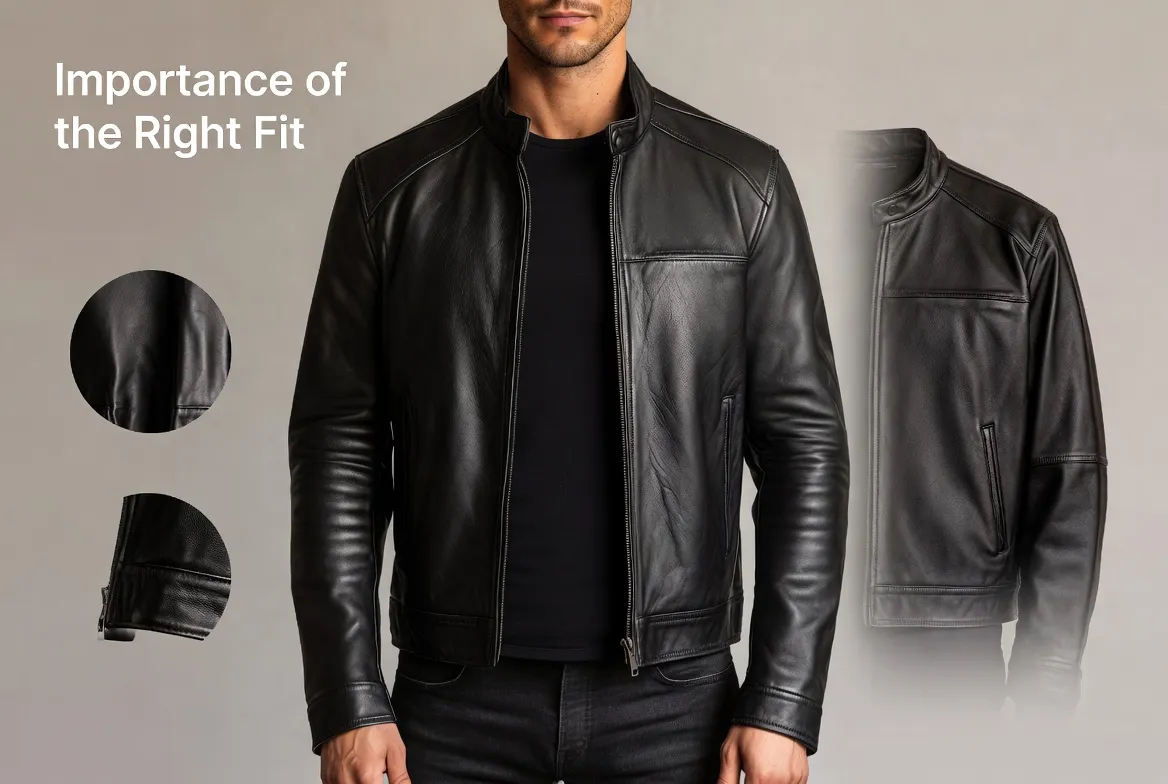
The Physics of the Hide: Material Selection
Before you commit to a silhouette, you must understand the mechanical behavior of the shell material. Real, high-density cowhide or lambskin is a “living” fiber structure. Over a six-month break-in period, the heat from your body actually shifts the protein bonds in the hide, causing it to mold to your anatomical curves. This creates a “Master Tailor” fit that improves with age. Conversely, our industrial-grade Vegan Leather is engineered for immediate, non-boxy consistency. It offers a friction-free experience right off the rack—ideal for those who prioritize a lightweight, cruelty-free footprint without the wait-time of a heritage break-in.
Anatomical Profiles: Men’s vs. Women’s Engineering
At America Jackets, we don’t just “size up or down”; we re-engineer the frame based on biological proportions. Our Men’s Leather Jackets are constructed with an emphasis on broader shoulder-to-armhole ratios and straight-cut industrial hems. For those with a muscular build or broader shoulders, we prioritize “Action Back” pleats and reinforced seams to allow for fluid movement without straining the hide. This build creates an aggressive, V-shaped profile that communicates structural strength.
Our Women’s Leather Jackets undergo a different technical process. We focus on a tapered waistline and refined shoulder lines to create a contoured, high-performance silhouette. These builds are engineered to be lightweight and flexible, ensuring the jacket moves with the wearer rather than resisting them. By optimizing the chest clearance and waist tapers, we ensure a “Master Tailor” fit that provides a sleek aesthetic while remaining functional for daily urban utility.


The Mechanical Clearance: Defining the Proper Fit
A “Master Tailor” fit is defined by zero-waste dimensions—the jacket should sit as close to the frame as possible without restricting anatomical movement. When auditing a build, like a high-density Shearling Leather Jacket, the critical checkpoint is the shoulder-to-armhole ratio. The shoulder seam must align precisely with your acromion process (the bony point at the top of your shoulder). If the seam hangs over, you lose the silhouette; if it sits too high, you lose arm mobility.
[Image of a diagram showing correct leather jacket shoulder seam alignment and sleeve length at the wrist]The sleeves must terminate exactly at the break of your wrist. Any longer, and the leather interferes with your hands; any shorter, and the industrial aesthetic is compromised. Crucially, the back panel must lay flat against your spine. A “puffed” or bubbling back indicates excess material in the mid-section, which destroys the V-taper. Unlike fast-fashion fabrics, leather does not “drape”—it holds its own weight. Therefore, precision in the initial sizing is mandatory to ensure the jacket functions as a piece of gear rather than a loose costume.
[Image of a diagram comparing a flat back panel fit versus a “bubbling” or puffed back on a leather jacket]While we generally advise against sizing up, you must account for your “Layering Strategy.” If you plan on wearing a heavy-thread hoodie or a thick knit, ensure you have approximately one inch of “pinch-room” in the chest. This maintains a non-boxy profile while allowing for friction-free movement. At America Jackets, we engineer our Men’s Leather Jackets with these industrial tolerances in mind, ensuring a sleek, high-performance fit right out of the box.
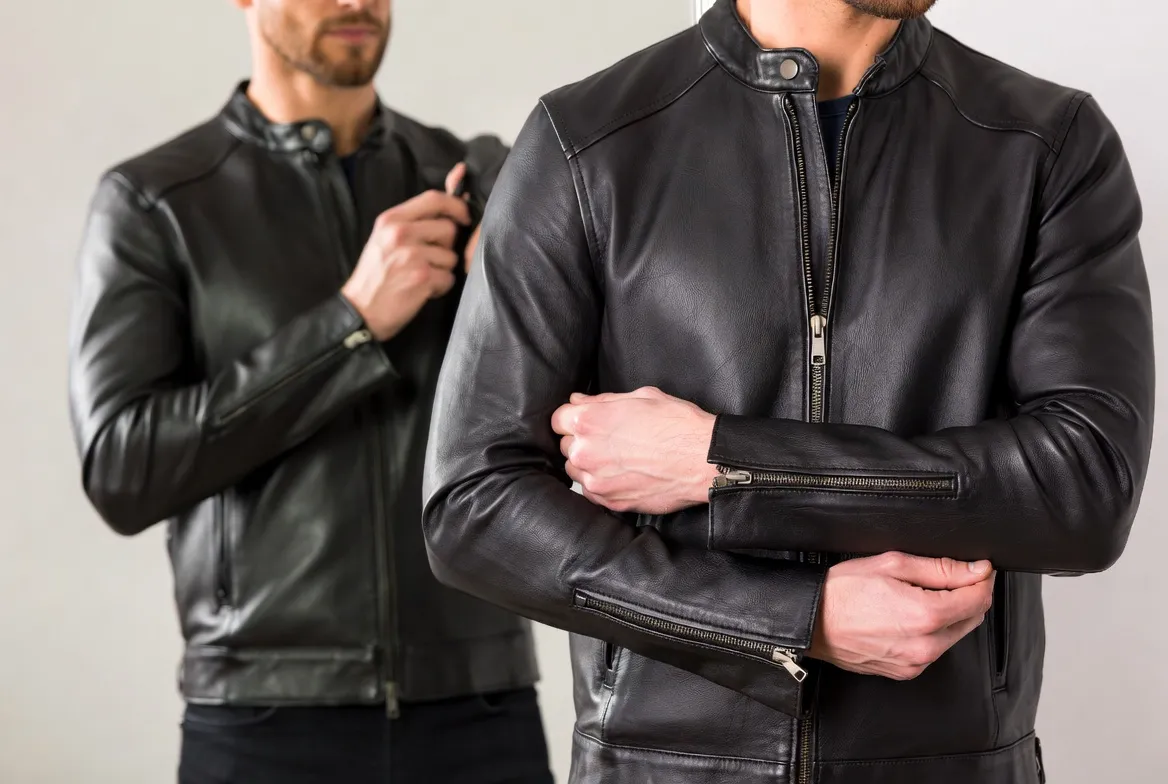
The Golden Rule: Precise Anatomical Measurement
Never estimate your dimensions. Leather is a high-density material with limited lateral stretch; a half-inch error can be the difference between a “Master Tailor” fit and a restrictive build. Before selecting your gear, consult a professional sizing guide to map your chest, shoulder-width, and sleeve length. A technical fit guide doesn’t just give you numbers—it provides the “mechanical clearance” required for your layering strategy. Understanding how a jacket sits on your specific frame is the foundation of long-term comfort and industrial style.
Industrial Blueprint: Matching Cut to Frame
Every jacket silhouette is a piece of engineering designed to emphasize specific physical traits. Whether you are deploying a rugged Men’s Bomber Jacket or a streamlined racer, the cut must serve your body type. We break down the blueprints by their structural impact:
- The Biker Build: Characterized by wide lapels and asymmetrical zippers, the Biker Leather Jacket adds significant visual volume to the chest and shoulders. It is the ideal choice for creating an aggressive, V-tapered silhouette on leaner frames.
- The Bomber Blueprint: With its rib-knit waist and cuffs, the bomber creates a rounded, “gentler” taper. It is perfect for those seeking a relaxed, non-boxy casual appearance that masks a heavier mid-section while maintaining a clean line.
- The Cafe Racer: Direct and minimalist. This silhouette is built for the “Modern Industrialist.” With a small snap-collar and a straight-through zipper, it offers a sleek, contemporary aesthetic that favors athletic or slim builds.
Technical Hides for Climate and Character
For sub-zero utility, the Shearling Leather Jacket is the heavy-hitter. The internal wool lining adds significant thermal mass and upper-body volume, making it the premier choice for broad-shouldered winter armor. If your priority is grit and durability, our Motorcycle Leather Jackets are built from 1.2mm+ hides to handle high-friction environments. Finally, for those who value heritage, a vintage-processed hide offers an immediate “broken-in” aesthetic, providing a weathered character that looks like it has already survived years on the road.


The Blueprint: Shopping by Anatomical Ratio
Selecting gear based on your specific frame isn’t about hiding your shape; it’s about optimizing your vertical and lateral ratios. If you are operating with an Athletic or Muscular Build, prioritize builds with reinforced chest clearance and slightly higher armholes to prevent the leather from binding during movement. For those on the Slimmer Spectrum, a direct, non-boxy cut is mandatory to avoid “swimming” in the material.
Verticality also dictates the build. A Leather Jacket for Tall Men requires an extended torso and sleeve length to maintain the industrial line, whereas a Leather Jacket for Shorter Frames should feature a cropped waist to prevent the jacket from shortening your legs. At America Jackets, we engineer our Men’s Leather Jackets to account for these specific height and weight variables, ensuring your gear looks like it was built for you, not borrowed.
The Day-One Dynamic: Initial Fit vs. Long-Term Wear
A frequent question in our workshop is: How should a leather jacket fit during the first wear? The answer is technical: it should feel “firmly seated.” Because leather is a natural fiber with a degree of lateral stretch, it will adapt to your high-friction points (shoulders and elbows) over time. However, you must be able to zip the jacket without straining the hardware. The waist should remain trim without excess “bunching” when you move your arms. This “snug but mobile” balance is the hallmark of a high-end build.
Cinematic Fit Profiles: Recreating the Star Silhouette
When we analyze celebrity gear, we aren’t looking at the name; we’re looking at the Anatomical Fit. These iconic jackets work because they follow the rules of the frame:
- The Precision Slim: The Ryan Gosling Drive Jacket is a masterclass in clean, low-profile tailoring. Its high-waist cut and slim sleeves create a sharp, streamlined silhouette that emphasizes an athletic frame without unnecessary bulk.
- The Heritage Power-Fit: The Top Gun G-1 Leather Jacket utilized by Tom Cruise is engineered for a bold, traditional V-taper. Its ribbed waist and heavy-duty collar are ideal for those seeking a confident, rugged appearance.
- The Casual Utility: The Dean Winchester Leather Jacket is the gold standard for a relaxed, industrial fit. It provides a more generous chest clearance while maintaining a sturdy, heavy-hide aesthetic—perfect for the daily grind.
- The Rugged Enforcer: Our Wolverine-inspired builds showcase how a 1.2mm distressed hide can add perceived “mass” to the upper body, turning a simple outfit into a mighty, high-impact silhouette.


The Technical Protocol: Selecting Your Build
If you are struggling with how to choose a leather jacket, stop guessing and follow our workshop protocol. This step-by-step process is designed to ensure your remote order results in a “Master Tailor” fit without the need for returns. By focusing on mechanical checkpoints rather than “feel,” you secure a piece of gear that is structurally optimized for your frame.
- Map Your Anatomical Ratios: Don’t rely on your t-shirt size. Use a flexible tape to measure your chest at its widest point and your shoulder-to-shoulder width. This baseline data determines your Mechanical Clearance.
- Select Your Material Density: Match the hide to your environment. Choose a 1.2mm cowhide for high-friction durability and thermal mass, or an industrial Vegan Leather for a lightweight, non-boxy drape that requires zero break-in period.
- Analyze the Blueprint: Match the jacket’s cut to your body type. If you seek a minimalistic, aerodynamic appearance, the Cafe Racer is your primary choice. If you require more upper-body volume and a bold, aggressive stance, the Biker or Motorcycle Style is the superior blueprint.
The ultimate leather jacket isn’t just about the aesthetic; it’s about how the build reinforces your confidence through a precision fit. Whether you opt for a rugged Motorcycle Jacket or a weathered Vintage piece, the goal is a garment that feels like an extension of your frame. When the measurements are honest and the style matches your anatomical proportions, there is no “bad” option—only high-performance gear built for the long haul.
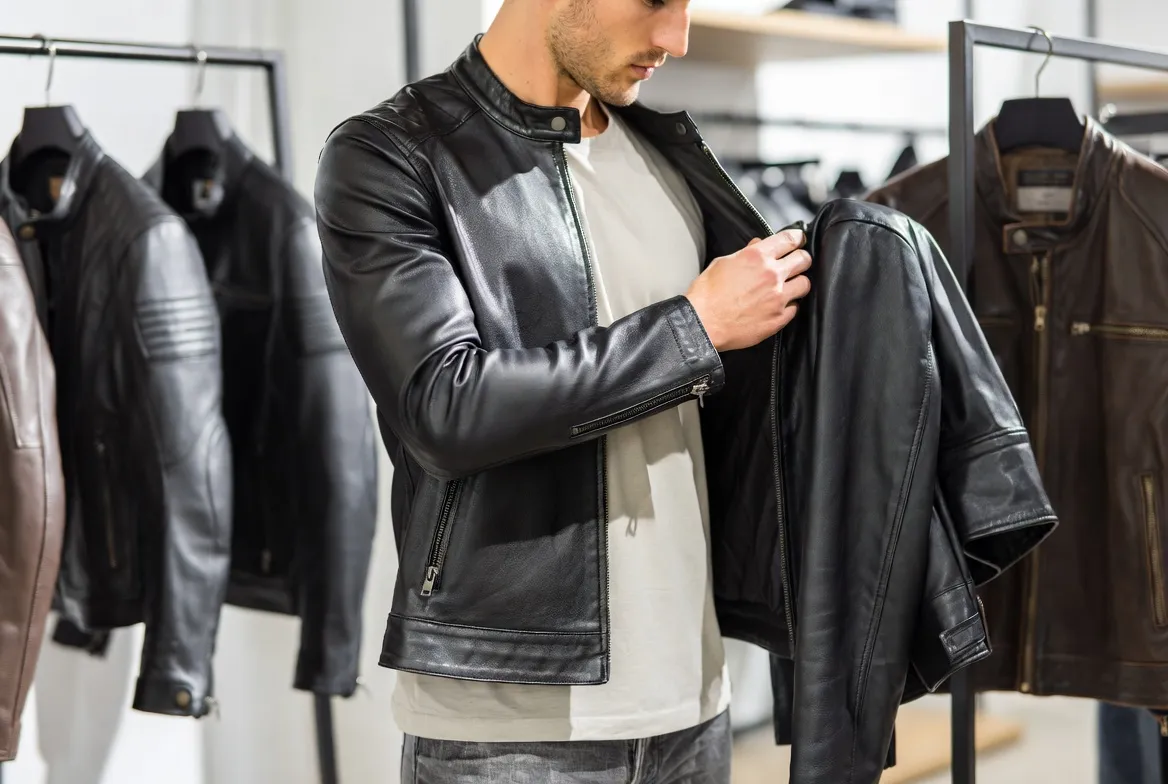
The Mechanical Advantage: Precision Over Estimation
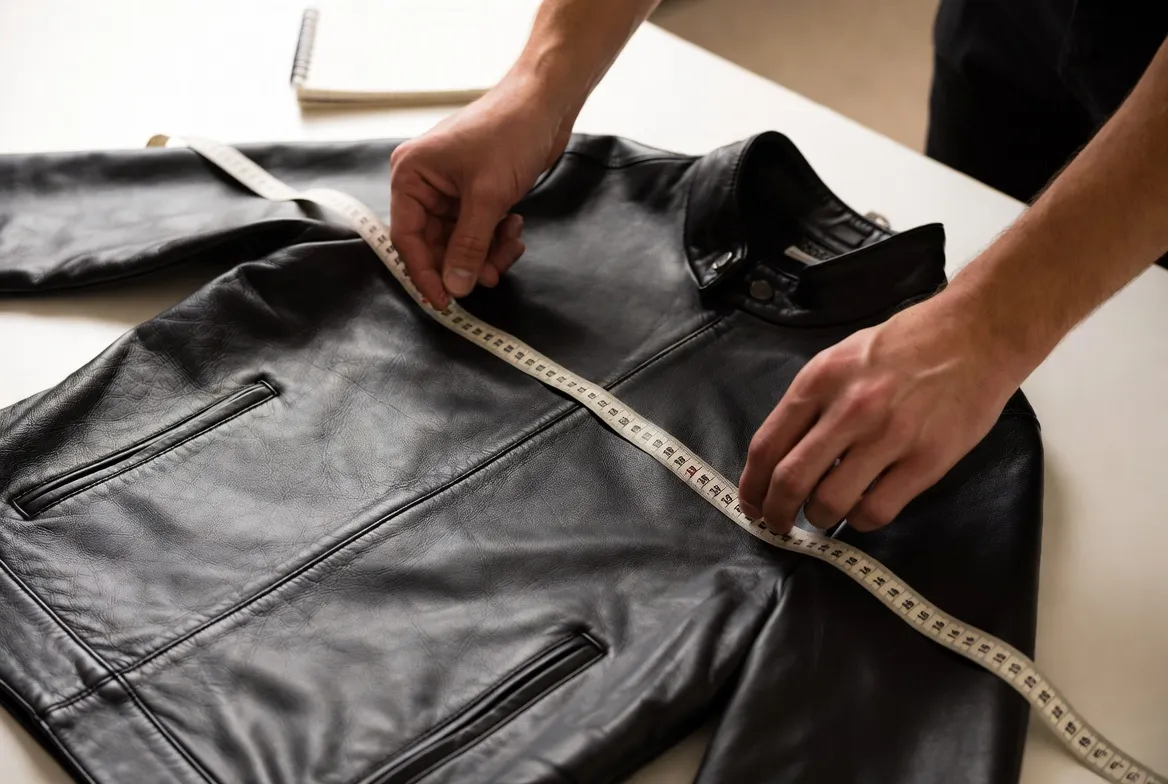
A “Master Tailor” result is impossible without accurate anatomical data. To secure a high-performance build, you must utilize a comprehensive measurement protocol. Focus on the four industrial cornerstones: the circumference of your chest at the fullest point, your natural waistline, the “bone-to-bone” width of your shoulders, and the sleeve length from the shoulder seam to the break of the wrist. This data ensures your gear is neither restrictive nor excessively loose, maintaining the structural integrity of the silhouette.
One of the most debated questions in the workshop is: Do you size up in leather jackets? The technical answer is a firm no—with one exception. High-density leather is a natural material that will relax and “mold” along high-tension fiber lines (like the elbows and shoulders) after 20-30 hours of wear. If you size up initially, you risk the jacket becoming “baggy” or losing its non-boxy profile as the material softens.
A “firm” fit on Day 1 is usually the correct indicator of a perfect fit on Day 100. The only time we recommend a marginal increase in sizing is if your **Layering Strategy** involves heavy-duty hoodies or thick industrial knits. Otherwise, trust the measurements and allow the hide to adapt to your frame for a truly custom feel.
Vertical Engineering: Selecting the Correct Jacket Shape
Achieving a balanced profile is a matter of vertical engineering. To optimize your frame, you must understand how hem length affects your proportions. A cropped hem (sitting at the belt line) creates the illusion of longer legs and a more athletic stance. Conversely, longer silhouettes are designed to streamline the torso and provide a more refined, non-boxy appearance. By prioritizing straight-cut, structured shoulders, you ensure a “Master Tailor” finish that holds its shape regardless of your body type.
Final Audit: The Build That Lasts
Mastering the art of selecting a leather jacket doesn’t require a fashion degree—it requires an understanding of your own anatomical blueprint. When you prioritize structural fit over passing trends, you secure a garment that functions as a permanent anchor in your wardrobe. Focus on mechanical comfort, insist on high-density materials, and trust the measurements of an honest build.
The ideal jacket isn’t just “trendy”; it’s a piece of industrial heritage that adapts to your frame and reflects your identity. Stop over-analyzing the options and commit to a build that is engineered for the long haul. Place your order today with America Jackets and secure professional-grade gear at a direct-to-consumer price. We offer FREE shipping for our crews in the USA, UK, Canada, and Australia. Choose your silhouette and hit the pavement.
Technical FAQs: Leather Jacket Fit & Body Type
Feel for the bony point at the top of your shoulder (the acromion). The jacket’s shoulder seam should sit directly on that point. If it drops toward your bicep, the jacket is too large and will look boxy. If it sits closer to your neck, the armholes will bind, restricting your movement.
Leather is a natural protein fiber that relaxes along high-tension points. A jacket that feels perfectly loose on Day 1 will likely look baggy by Day 30. A firm, snug fit at the start ensures that as the material molds to your anatomical frame, it results in a custom-tailored silhouette that stays sharp for years.
To optimize your height, follow the belt-line rule. For shorter frames, a cropped waist (Cafe Racer style) elongates the legs. For taller frames, a slightly longer torso prevents the jacket from looking shrunken. At AJ, we engineer our hems to maintain these vertical ratios for a balanced, non-boxy appearance.
Stand naturally and have someone look at your back. If the leather bubbles or puffs away from your spine, the torso is too long or the waist is too wide for your frame. A proper fit should lay flat against your back panels. If it bubbles now, it will only become more pronounced as the leather softens.
Yes. Action Back pleats are hidden expansion joints at the shoulder blades. They allow a slim-cut jacket to expand when you reach forward or drive, providing the sleek look of a fitted piece without the restrictive feel. For muscular builds, this is the master tailor secret to a perfect V-taper.


