
Guides
What Is Leather Bunching? Causes, Prevention, and Structural Remedies
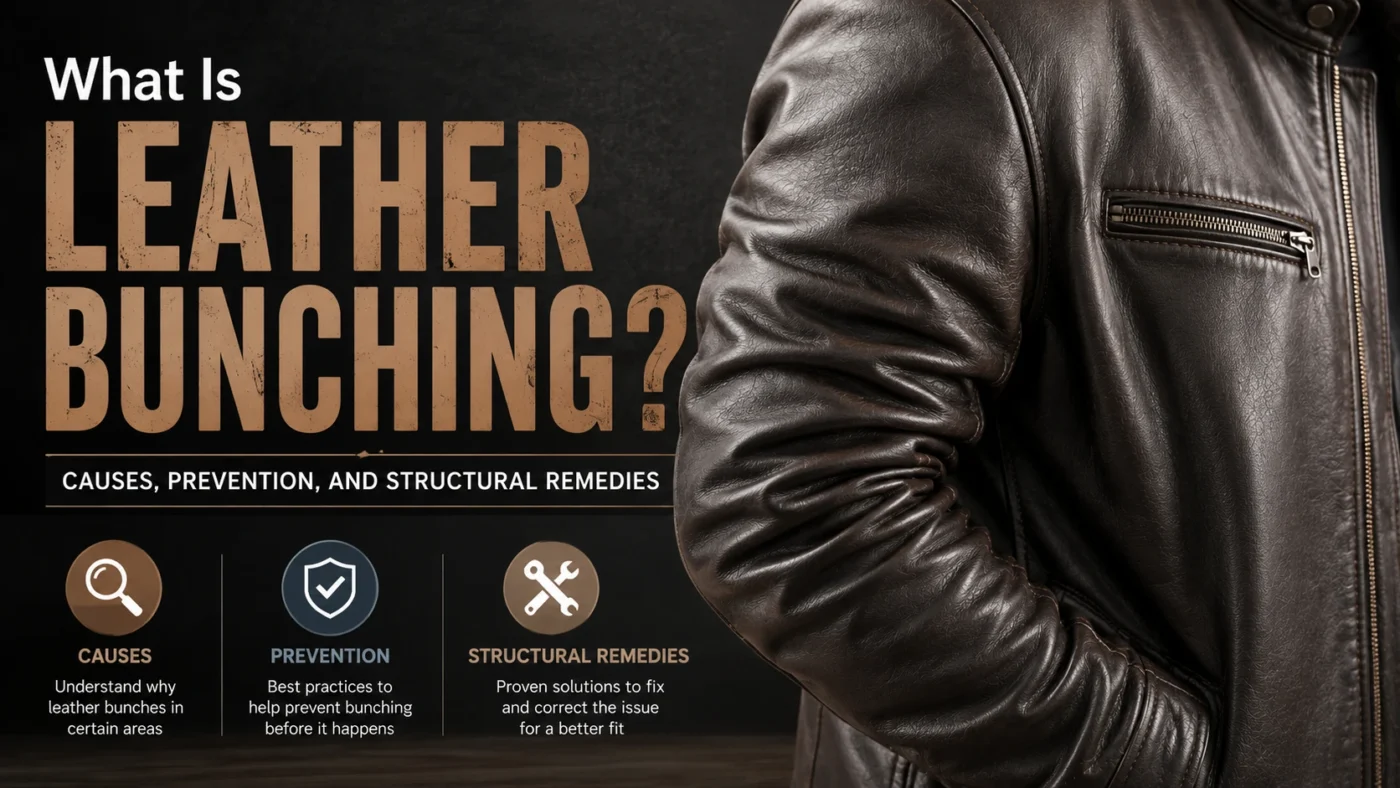
The procurement of a premium leather jacket represents a significant financial and stylistic investment. However, over extended periods of active wear or due to foundational storage errors, structural deviations can manifest within the hide. Among these physical distortions, leather bunching frequently accompanied by localized wrinkling, puckering, and seam distortion is a common problem. Unlike synthetic fabrics that can be effortlessly ironed, real animal hide features a complex biological matrix that reacts uniquely to mechanical stress, thermal fluctuations, and atmospheric humidity.
For individuals reviewing high-tier outerwear collections or auditing custom garment sizing matrices on specialized digital storefronts such as America Jackets, understanding the mechanics of garment deformation is essential. This technical analysis provides an objective evaluation of why leather bunching occurs, how mechanical wrinkling alters the hide, and what approved structural removal methods can be deployed to restore the garment’s pristine silhouette.
Technical Definition: What Is Leather Bunching and Puckering?
Leather bunching is defined as an irregular, localized gathering or overlapping of hide material along specific zones of a garment. This physical distortion breaks the smooth, intended silhouette of the jacket, resulting in a wavy, loose, or pocketed appearance.
Anatomy of a Seam Puckering / Bunching Failure
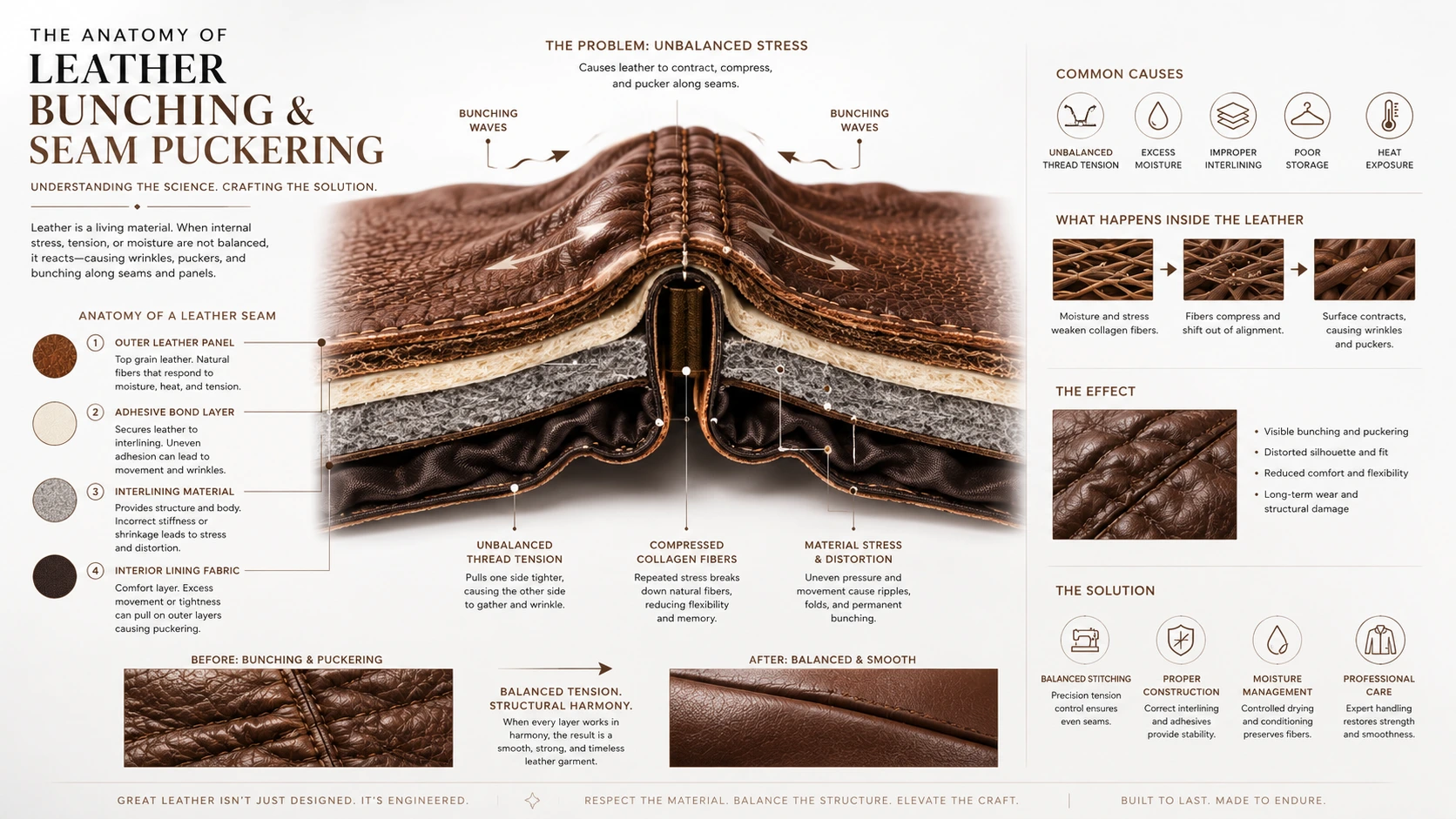
This structural failure must be differentiated into two distinct industrial categories:
1. Material Displacement (Bunching)
This occurs across expansive panels of the garment, such as the upper back, the chest area, or around the inner elbow joints. It is characterized by large, soft waves of excess hide that fail to lay flat against the individual wearer’s physical frame.
2. Seam Puckering
Seam puckering is a localized variation of bunching that occurs strictly along structural stitch lines, such as zipper mountings, shoulder joins, and pocket flaps. It manifests as a series of tight, repetitive mini-wrinkles that travel parallel to the thread line, caused by uneven mechanical tension during industrial sewing operations.
Core Causes: Why Does Leather Bunching Occur?
Garment deformation is rarely the result of a single isolated vector; rather, it is induced by a combination of biological material physics, structural tailoring tolerances, and environmental exposures.
1. Biological Density Mismatches
Because real leather is processed from organic animal skin, the density of the interwoven collagen fibers varies significantly across a single hide sheet:
- The Structural Variation: Hides harvested from the flank or belly regions of livestock possess a looser, more elastic reticular fiber layout compared to the ultra-dense, rigid structures found along the spine or shoulder regions.
- The Failure Mode: If a garment is constructed utilizing mismatched hide panels where a highly elastic flank panel is stitched directly to a rigid spine panel, the variations in fiber elongation will cause the looser section to bunch and buckle under normal mechanical movement.
2. Structural Sizing Inaccuracies (The Fit Vector)
Excess material is the primary architectural driver of bunching. If a leather jacket is acquired in a sizing matrix that exceeds the physical dimensions of the wearer—specifically along the chest width or sleeve length the excess surface area has no structural support. Consequently, gravity compresses the unsupported hide downward, forcing the material to gather into thick, horizontal waves around the waistline or wrists.
3. Differential Textile Shrinkage
A high-end leather jacket is a multi-layered composite asset comprised of the exterior hide, an structural interior interlining, and a textile lining (such as polyester, satin, or cupro).
- The Mechanism: When a jacket is exposed to heavy moisture or improper thermal conditions, each individual material layer contracts at a highly divergent rate. If the interior lining fabric shrinks extensively while the exterior hide remains static, the underlying tension forces the outer leather to pucker and bunch outward along the securing seam boundaries.
Technical Protocols: How to Remove Wrinkles and Bunching
Restoring the structural flatness of a distorted leather panel requires precise, low-temperature thermal management and mechanical pressure. Traditional high-heat steam irons designed for cotton must never be applied directly to animal hide, as extreme heat will instantly denature the protein matrix, causing irreversible calcification, structural shrinkage, and permanent surface cracking.
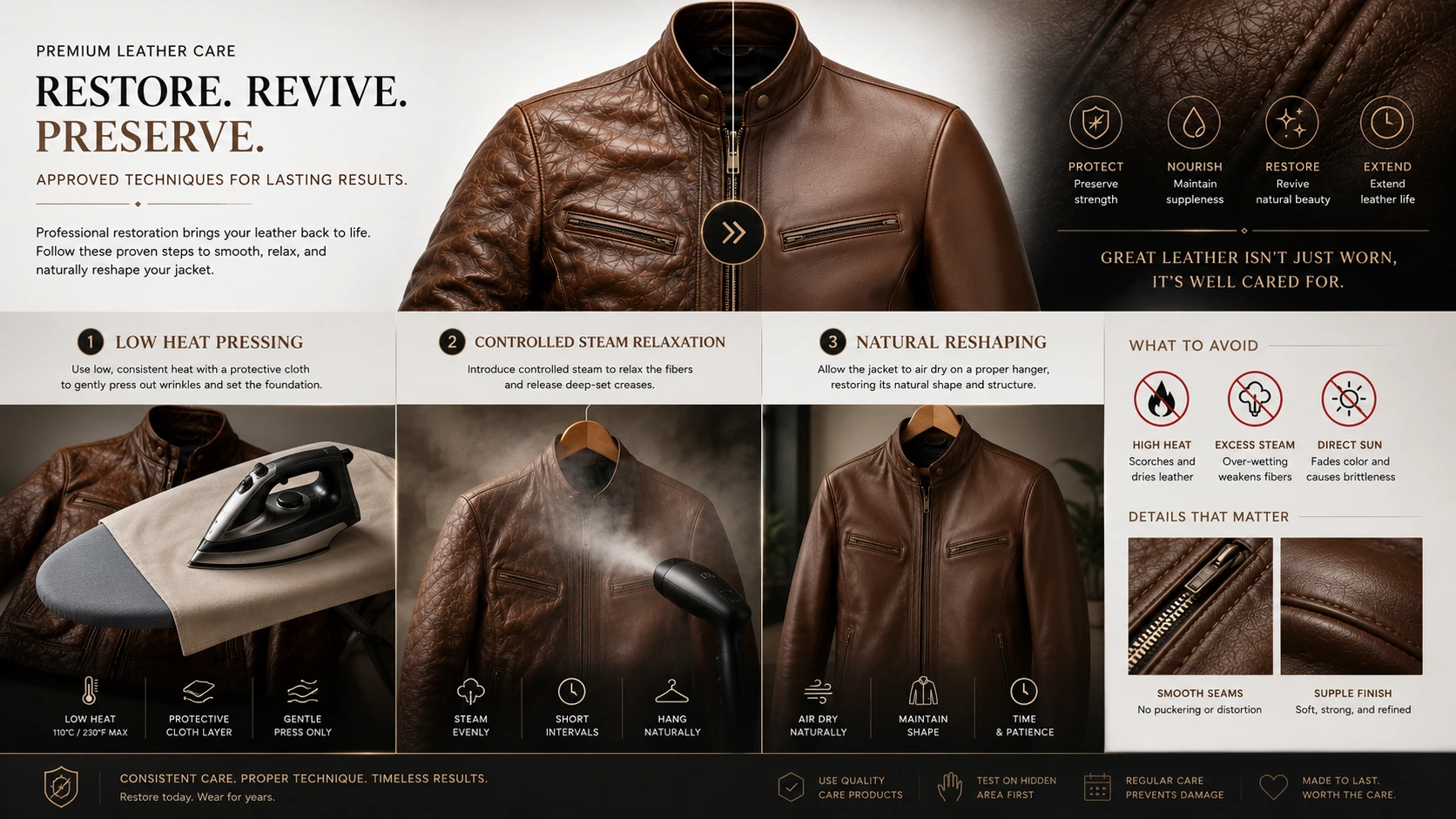
Protocol A: The Protected Low-Heat Compressed Ironing Method
To eradicate persistent wrinkles and flatten compressed bunching zones safely, the following sequence must be meticulously executed:
- The leather garment must be placed completely flat across a firm, level ironing board.
- The affected panel must be smoothed out manually to minimize overlapping folds.
- A heavy, clean sheet of brown parchment paper or a thick, 100% white cotton towel must be placed over the leather surface to act as an absolute thermal shield.
- An industrial garment iron must be configured to its absolute lowest heat threshold (the “silk” or “rayon” setting) with the steam function completely deactivated.
- The iron must be pressed firmly over the protective paper shield, moving continuously in slow, linear paths. The iron must never remain static over a single coordinate for more than two to three seconds.
- The protective shield must be removed immediately after pressing to allow the localized thermal energy to dissipate naturally.
Protocol B: The Ambient Vapor Hanging Method (The Bathroom Steam Effect)
For generalized, minor wrinkling across the entire frame of the jacket, a non-contact hydration methodology can be deployed:
- The leather jacket must be secured on a wide, contoured wooden hanger to preserve the correct shoulder geometry.
- The garment is suspended inside a closed bathroom facility while a high-temperature shower is activated to generate ambient steam.
- The jacket must remain isolated within this humid environment for fifteen to twenty minutes, ensuring that no direct water droplets make contact with the exterior hide.
- The microscopic ambient moisture molecules will gently penetrate the semi-porous grain, softening the dehydrated collagen links.
- The jacket must then be transferred to a dry, well-ventilated room where the natural weight of the hide will draw out the wrinkles vertically as the material dries at room temperature.
Material Maintenance Matrix: Shrinking vs. Flattening
When managing leather bunching caused by sizing errors, structural shrinkage is occasionally attempted by consumers. The operational differences between safe structural flattening and aggressive material shrinking are compared within the technical framework below:
| Structural Directive | Safe Panel Flattening (Wrinkle Eradication) | Aggressive Material Shrinking (Sizing Correction) |
| Primary Objective | To realign micro-fibers and restore a flat surface contour. | To forcibly contract the entire vertical collagen matrix. |
| Thermal Range | Low heat (Under 45°C) via an absolute dry barrier. | High heat via direct boiling water submersion or tumble drying. |
| Moisture Involvement | Zero direct fluid contact; ambient vapor only. | Deep, saturating liquid immersion followed by forced dehydration. |
| Structural Risk Rating | Low; maintains original textile elasticity. | Critical; high probability of material hardening and splitting. |
| Recommended Verdict | Approved: Safe for all high-grade outerwear. | Discouraged: Destroys natural oils; alters fit permanently. |
Proactive Prevention: Safeguarding Outerwear Silhouette
To entirely eliminate the onset of bunching, wrinkling, and puckering, explicit preservation protocols must be structured within everyday wardrobe management routines.
Correct Hanging Geometry
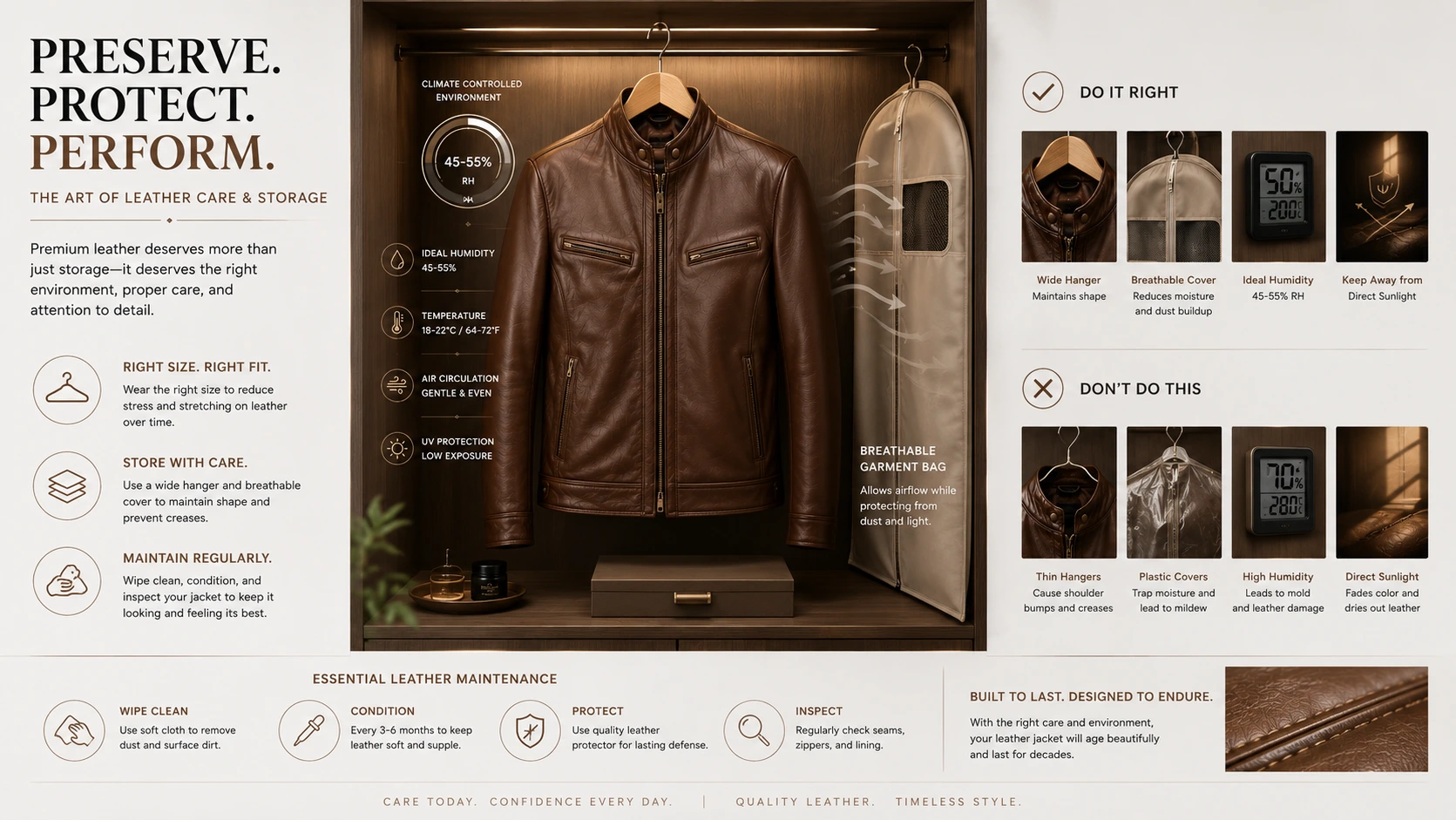
A leather jacket must never be suspended utilizing a thin wire hanger or a narrow plastic hook. The concentrated downward weight of the hide over a narrow surface area will distort the shoulder seams, forcing excess material to migrate and bunch around the armpits. The garment must always be mounted on a wide, anatomically curved contoured hanger constructed from solid hardwood.
Storage Climate Parameters
Leather must be stored inside an environment where the relative humidity is regulated between 45% and 55%, completely shielded from direct ultraviolet sunlight. Excessive dry air accelerates fiber dehydration, causing the hide to harden into deep, permanent creases. Conversely, excessive humidity triggers moisture absorption within the interior linings, inducing differential shrinkage and terminal seam puckering. Furthermore, the use of non-porous plastic garment storage bags must be strictly avoided; the leather must be allowed to breathe naturally inside a cotton or canvas dust cover.
Conclusion
Leather bunching, puckering, and wrinkling are common structural issues that can develop over time due to sizing inaccuracies, material density variations, environmental exposure, or improper storage practices. While these deformations may affect the appearance of a leather jacket, they do not necessarily indicate permanent damage when addressed using approved restoration techniques.
Understanding the distinction between large-panel bunching and seam puckering allows owners to identify the root cause of the problem and select the most appropriate corrective approach. Safe low-heat pressing methods and controlled ambient steam treatments can effectively restore the garment’s original silhouette without compromising the integrity of the leather. Equally important is preventive care, including proper hanger selection, climate-controlled storage, and routine maintenance, which significantly reduces the risk of future deformation.
For those investing in premium outerwear, preserving the structural integrity of the hide is just as important as maintaining its visual appeal. With proper handling and storage, a high-quality leather jacket can retain its shape, comfort, and refined appearance for many years, ensuring that it continues to deliver both style and long-term value.
Frequently Asked Questions
Leather jackets typically bunch up due to improper sizing, excess material, uneven hide density, lining shrinkage, or prolonged improper storage. Oversized jackets are especially prone to developing folds around the waist, sleeves, and elbows.
Yes. Minor to moderate bunching can often be improved using low-heat pressing methods, controlled steam exposure, and proper reshaping techniques. Severe structural issues may require professional leather repair.
Leather bunching affects larger sections of the jacket and creates broad waves in the material. Seam puckering occurs directly along stitch lines and appears as small, repetitive wrinkles caused by uneven sewing tension or lining shrinkage.
Yes, but only with extreme caution. A protective cotton cloth or parchment paper should always be placed between the iron and the leather, and the iron should be set to its lowest heat setting without steam.
Yes. Indirect steam from a hot shower can help relax leather fibers and reduce minor wrinkles. However, the leather should never be exposed to direct water contact or excessive heat.
Not necessarily. Even premium leather jackets can develop bunching due to incorrect sizing, environmental conditions, or natural wear patterns. The issue is often related to fit and maintenance rather than material quality.
Although leather can shrink when exposed to high heat and moisture, this method is generally not recommended. Aggressive shrinking can damage natural oils, cause stiffness, and permanently alter the fit of the garment.
Store the jacket on a wide wooden hanger in a cool, well-ventilated area with moderate humidity levels. Avoid wire hangers, overcrowded closets, and plastic garment bags that restrict airflow.
Elbows and sleeves experience frequent bending and movement, causing natural compression of the leather fibers. Over time, these high-flex areas can develop wrinkles and localized bunching.
If ignored for extended periods, severe bunching and puckering can become more difficult to correct. Early intervention, proper storage, and regular maintenance greatly improve the chances of restoring the jacket's original shape.


Related Posts
Jacket Materials and Colors Guide: Everything You Need to Know
Continue Reading4th of July Outfits, Jackets and Independence Day Style Guide
Continue ReadingWhat Is Faux Leather? Everything You Need to Know Before Buying
Continue Reading